
When buying or selling a flat, homeowners often get confused about the difference between circle rate and market rate. Why is circle rate usually lower than market rate in India? And more importantly, how does this affect property deals?
Understanding these two concepts is crucial because they directly impact stamp duty, property registration charges, home loan approvals, and even capital gains tax. Let’s break it down clearly.
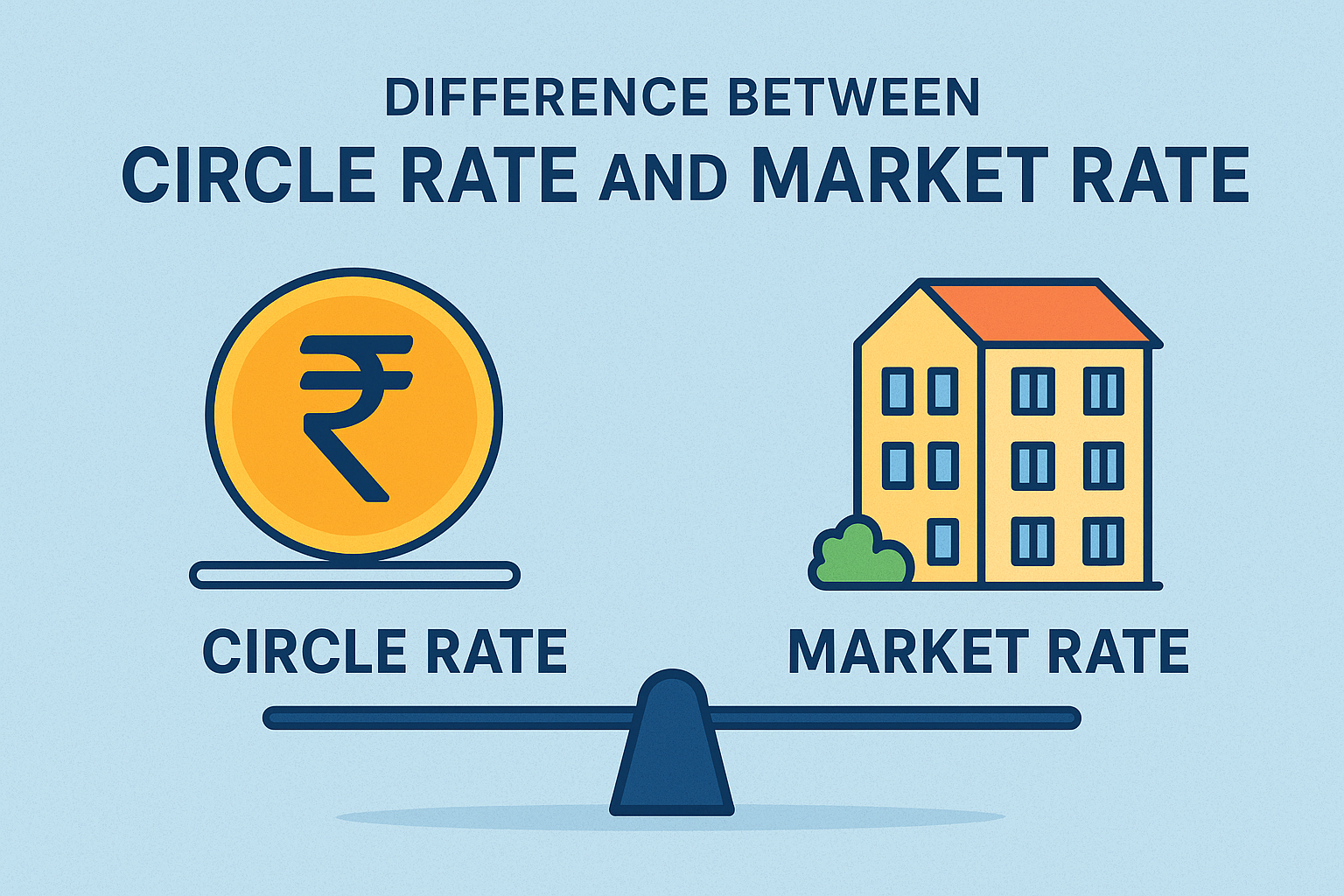
✅ What is Circle Rate in Property?
The circle rate (also called ready reckoner rate or guideline value) is the minimum property value set by the government for registration purposes.
- Used to calculate stamp duty and registration fees
- Fixed by state governments and differs by city and locality
- Acts as a legal benchmark to prevent undervaluation of property transactions
👉 Example: If the circle rate in a Pune locality is ₹6,000 per sq. ft., your flat cannot be registered below this rate — even if the actual deal is cheaper.
learn more about stamp duty and property registration in India.
✅ What is Market Rate of Property?
The market rate (also known as market value) is the actual price agreed between buyer and seller. It reflects real-time demand and supply in the real estate market.
It depends on:
- Location & connectivity
- Amenities & construction quality
- Property age & condition
- Current demand in the resale property market
👉 Example: If similar flats in your society are selling at ₹8,000 per sq. ft., the market value of your home will likely be around the same.
🔑 Key Difference
Here’s a clear comparison to understand the difference in real estate transactions:
| Aspect | Circle Rate | Market Rate |
|---|---|---|
| Who Decides? | Government | Buyer & Seller |
| Purpose | Registration, Stamp Duty | Actual Transaction Price |
| Flexibility | Fixed, reviewed occasionally | Dynamic, based on demand |
| Usually Higher? | ❌ Lower | ✅ Higher |
👉 In short: The circle rate is the government’s minimum valuation, while the market rate is the actual deal value in resale transactions.
💡 Why is Circle Rate Lower in India?
A common question buyers and sellers ask is: why is circle rate lower than market rate?
- Circle rates are revised slowly by governments.
- Market demand, amenities, and infrastructure push prices up faster.
- Market value reflects true worth; circle rate lags behind.
This gap is why most properties in cities like Pune, Mumbai, and Delhi sell above circle rates.
📈 How it Impacts Property Deals
Knowing the difference helps you understand its effect on property transactions:
- Stamp Duty & Registration Charges – Calculated on the higher of circle rate or market value.
- Capital Gains Tax – Even if you sell at a lower price, tax is calculated using the circle rate.
- Home Loan Approvals – Banks often consider circle rate while approving resale property loans.
- Negotiation in Resale Market – Buyers aim closer to circle rate, sellers push for market value.
👉 Transitioning from confusion to clarity, this difference directly impacts your property profit or cost.
❓ FAQs on Circle Rate vs Market Rate
Q1. Can I sell my flat below circle rate in India?
No, you cannot. By law, a property cannot be registered below the circle rate.
Q2. Can I register property below circle rate?
No, registration must always be done at circle rate or above.
Q3. What happens if market value is higher than circle rate?
Stamp duty and registration charges are calculated on the higher value, usually the market rate.
Q4. How does circle rate affect home loan approval for resale flats?
Banks check the valuation against circle rate. If your market rate deal is much higher, banks may sanction a lower loan.
Q5. How to check circle rate of property in Pune, Delhi, or Mumbai?
You can visit your state’s official registration website or consult your local registrar office.
📌 Key Takeaway: Circle Rate vs Market Rate
👉 The difference between circle rate and market rate in resale properties is simple:
- Circle Rate = Government’s minimum valuation used for stamp duty and registration.
- Market Rate = Actual transaction value based on demand, location, and amenities.
This difference affects taxes, property registration, home loans, and negotiation in resale deals.
🎯 Conclusion
Understanding the difference helps you make smarter decisions as a buyer or seller. While the circle rate sets the legal floor price, the market rate reflects the true worth of your property.
✅ If you want to sell your flat at the best market value or buy a resale property at the right price, reach out to Resale Expert for trusted guidance and smooth transactions.

Join The Discussion